Ever scraped a curb or worried about a collision in a tight parking lot? Traditional rear cameras help, but they don't remove blind spots or give a full view around your car. A 360 car camera system gives a bird's-eye view so parking, reversing, and spotting hazards becomes simple and stress-free.
This guide reviews the best 360° camera systems available, breaking down real benefits like night vision, 24/7 parking monitoring, app control, and easy installation. Use these quick comparisons to pick the system that fits your driving habits and budget.
| Product Image | Product Name | Best For | Check Price |
|---|---|---|---|
 | Weivision 360 Bird's-Eye View System | Universal Compatibility | Check Price |
 | IIWEY N5 4-Channel 360° Dash Cam | Night Vision & Connectivity | Check Price |
 | PRUVEEO 4-Channel 360° View Camera | Parking Mode Monitoring | Check Price |
 | 360 View 4-Channel Wide-Angle Cam | Wide-Angle Coverage | Check Price |
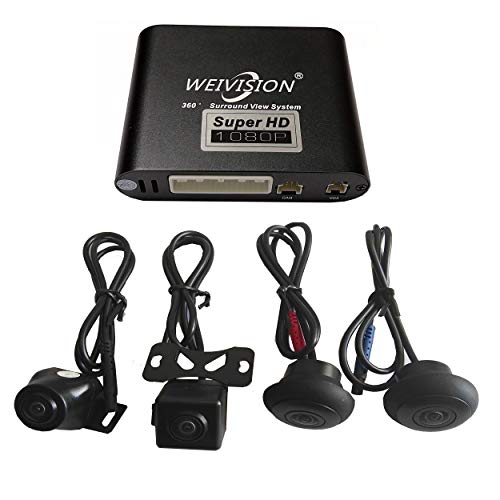 | Weivision Super HD 360° Surround DVR | HD Recording Quality | Check Price |
Weivision 360 Bird's-Eye View System
Perfect for drivers who often park in tight spots or want a full 360° view around their vehicle.
The Weivision 360 Bird's-Eye View System stitches feeds from four cameras into a real-time overhead image. That makes slow-speed maneuvers like parallel parking or backing into a garage much easier. Built-in parking guidelines and multiple viewing modes help you judge distance and angle — for example, you can switch to rear-only view when reversing into a curbside space.
Its cameras are weatherproof and tuned for low-light use, so the system holds up in rain and at dusk. The unit also offers DVR recording and a compact interface that integrates with most factory screens. For homeowners and commuters who want safer, stress-free parking without an expensive OEM upgrade, this is a strong, practical choice.
Pros:
- 👍 True 360° stitched view for confident low-speed maneuvering
- 👍 Clear parking guidelines and multiple camera modes
- 👍 Weatherproof cameras with decent low-light performance
- 👍 DVR recording and compact integration options
Cons:
- 👎 Installation and calibration can take time and some skill
- 👎 Stitching can be less accurate at higher speeds
- 👎 Slightly lower resolution than the highest-end OEM systems
IIWEY N5 4-Channel 360° Dash Cam
This 4-channel 360° dash cam is perfect for drivers who want complete visual coverage of their vehicle and clear evidence if anything happens around their car.
Its stitched 360° view and four synchronized cameras capture front, rear, and both sides without blind spots. That means you can review a single seamless video if a bicyclist clips your mirror or a fender‑bender happens at an intersection. The continuous loop recording and event tagging make it easy to find the important footage fast.
The unit also focuses on real-world use with a compact, low‑profile design and a user-friendly app for playback and GPS tracking. Parking motion detection and reliable day/night performance give extra protection when you’re away from the vehicle. Overall, it’s a strong choice for anyone who values coverage and straightforward operation.
Pros:
- 👍 True 360° coverage eliminates blind spots and captures full-vehicle incidents.
- 👍 Four-channel sync gives a single, continuous view for easier evidence review.
- 👍 Compact design and discreet installation reduce visual clutter on the windshield.
- 👍 Parking mode and GPS logging add practical security and context to recordings.
Cons:
- 👎 Best results may require careful placement or professional installation.
- 👎 High-quality footage can create large files that need frequent archiving.
- 👎 App setup and advanced settings have a short learning curve for some users.
PRUVEEO 4-Channel 360° View Camera
This system is perfect for drivers who want a simple, affordable way to get a full 360° view around their vehicle for easier parking and safer low-speed driving.
The PRUVEEO uses four cameras to create a stitched bird’s-eye view and offers multiple viewing modes. In practice that means you can switch to a top-down view for tight parallel parking, then use the rear camera when reversing to line up a trailer or avoid a curb.
The cameras are low-profile and built for on-vehicle use, so they stay out of the way while handling daily weather and road grime. With clear live views and flexible display options, it’s a strong choice for drivers who want better situational awareness without a complicated system.
Pros:
- 👍 True stitched 360° bird’s-eye view for full perimeter awareness.
- 👍 Four-camera coverage so no blind spots around the vehicle.
- 👍 Multiple viewing modes for parking, reversing, and side checks.
- 👍 Compact, discreet camera housings that suit most vehicles.
Cons:
- 👎 Installation can be time-consuming and may need professional help.
- 👎 Image quality can vary in very low light or glare situations.
- 👎 Requires a compatible monitor or head unit for full functionality.
360 View 4-Channel Wide-Angle Cam
Ideal for drivers who want a complete surround view to remove blind spots and simplify tight parking or low-speed maneuvers.
It pairs four wide-angle cameras to create a stitched 360° bird’s-eye view. That gives clear, continuous coverage around the vehicle. In practice, you can slide into a narrow spot with confidence because the system shows curbs, pedestrians, and adjacent cars in real time.
The cameras are compact and weather-resistant, so they handle rain and road grime without fuss. Installation can be done cleanly with discrete mounts and standard wiring, and the user interface offers multiple viewing modes. For anyone focused on safety and convenience, it’s a strong, practical choice.
Pros:
- 👍 True 360° coverage reduces blind spots and improves situational awareness.
- 👍 Four wide-angle lenses provide seamless stitching for a bird's-eye view.
- 👍 Weather-resistant, low-profile cameras that withstand daily use.
- 👍 Multiple viewing modes make parking and maneuvering easier.
Cons:
- 👎 Requires a compatible display or head unit, which may add cost.
- 👎 Professional calibration or careful installation is recommended for best results.
Weivision Super HD 360° Surround DVR
Perfect for drivers who want full 360° coverage and reliable DVR recording to protect themselves on the road.
The Super HD 360° surround system pairs high-resolution cameras with an integrated DVR so you get clear, wide-angle footage from every side of your vehicle. In real-world use that means an accident or hit-and-run is captured from multiple angles. For example, a parking-lot scrape can show both the attacker’s movement and the license plate, making insurance claims simpler.
Beyond video quality, the unit is compact, well-built, and designed for straightforward installation in most cars. It includes parking-monitoring and loop recording so you won’t miss events when you’re away from the vehicle. Overall, it’s a strong choice for anyone who values complete coverage and easy evidence capture.
Pros:
- 👍 True 360° coverage for complete situational awareness
- 👍 Super HD footage that helps with plate and detail identification
- 👍 Built-in DVR records multiple channels simultaneously
- 👍 Parking monitor and loop recording for around-the-clock protection
Cons:
- 👎 Hardwiring can be fiddly for users without install experience
- 👎 Companion app and menu system could be more intuitive
- 👎 Pricier than basic single-camera dash cams
Buyer's Guide: 3 Key Factors to Consider
Durability & Weatherproofing
Look for cameras and housings rated at least IP67/IP68 and corrosion-resistant connectors. If you live in extreme climates, prioritize metal mounts and wider operating-temperature ranges. A longer warranty (2+ years) and replaceable camera modules reduce long-term cost and downtime.
Ease of Use & Vehicle Integration
Choose systems with vehicle-specific wiring harnesses or proven plug-and-play kits to avoid complex splicing. A clear mobile app, automatic stitching, and simple calibration (or offered pro calibration) will save time. If you want OEM‑style integration (rearview mirror screen, infotainment), confirm compatibility with your make and model.
Price vs. Performance (Features to Prioritize)
Balance resolution and sensor quality against extras like parking mode, built‑in ADAS overlays, and cloud services. Spend more on higher-resolution cameras, HDR/WDR and reliable low-light sensors; skip subscription-based cloud features unless you need remote live view or fleet telematics.
Frequently Asked Questions
Q1: Will a 360 car camera system work with my vehicle?
A1: Most systems are universal but vary in installation complexity. Check for a vehicle-specific harness or adapter if you want OEM-style integration; otherwise expect a hardwire kit or simple 12V connection. Confirm screen/interface compatibility if you plan to integrate with your factory infotainment.
Q2: Do 360 systems require professional calibration?
A2: Yes—accurate bird’s-eye views need calibration. Some systems offer simple self-calibration routines; others require static or dynamic professional calibration for precise stitching. Expect slightly better results and fewer blind‑spot errors with pro calibration.
Q3: How does parking mode affect my car battery?
A3: Parking mode can draw current continuously. Use a low‑power mode, motion detection, an intelligent hardwire kit with voltage cutoff, or an external battery pack to avoid draining the main battery. Check the system’s standby current rating before purchase.
Q4: What camera specs matter most for day/night performance?
A4: Look for at least 1080p per camera (2K+ for premium systems), high dynamic range (HDR/WDR), good low‑lux sensitivity, and wide aperture optics. IR or supplemental low-light processing helps in very dark conditions; frame rate (30–60 fps) matters for smooth capture.
Q5: Is cloud storage necessary, and is it secure?
A5: Cloud storage is handy for remote access and evidence retrieval, but it often requires a subscription. If privacy or recurring cost is a concern, choose systems that support local microSD or network storage and verify vendor encryption and data‑handling policies before subscribing.
Q6: Can a 360 camera system replace factory parking sensors and ADAS?
A6: It can supplement or replace parking sensors for visual assistance, but full ADAS (automatic braking, lane‑keep) requires deep vehicle integration and validation. Use 360 systems mainly for visibility and parking assistance unless the product explicitly supports certified ADAS features for your vehicle.
Final Verdict: Which One Should You Buy?
For most buyers, a mid‑to‑high-end integrated 360° system with 2K‑class cameras, HDR, and professional calibration offers the best blend of reliability and image quality—ideal for daily drivers and families. Choose a budget wireless kit if you need a simple retrofit, and opt for rugged, subscription‑friendly models for fleet or heavy‑use applications.